⌬ AI-ENGINEER HACKATHON · DEEP-RESEARCH PLANNER · APR 2026

The Architect's
co-pilot.

PLAN.AI takes a one-line idea and returns a citation-grounded technical blueprint in 22 sections, a Mermaid C4 diagram, and a Shipping Floor that compiles the blueprint into Architect / Executor / Auditor tasks. Underneath: nine source integrations, a three-depth research engine including a STORM-lite multi-persona orchestrator, and a Vercel-ready deploy where every API key is supplied client-side.
ReactViteTypeScriptVercel Edge OpenAI / OpenRouterTavilyFirecrawlMermaid C4
PLAN.AI workspace — idea intake
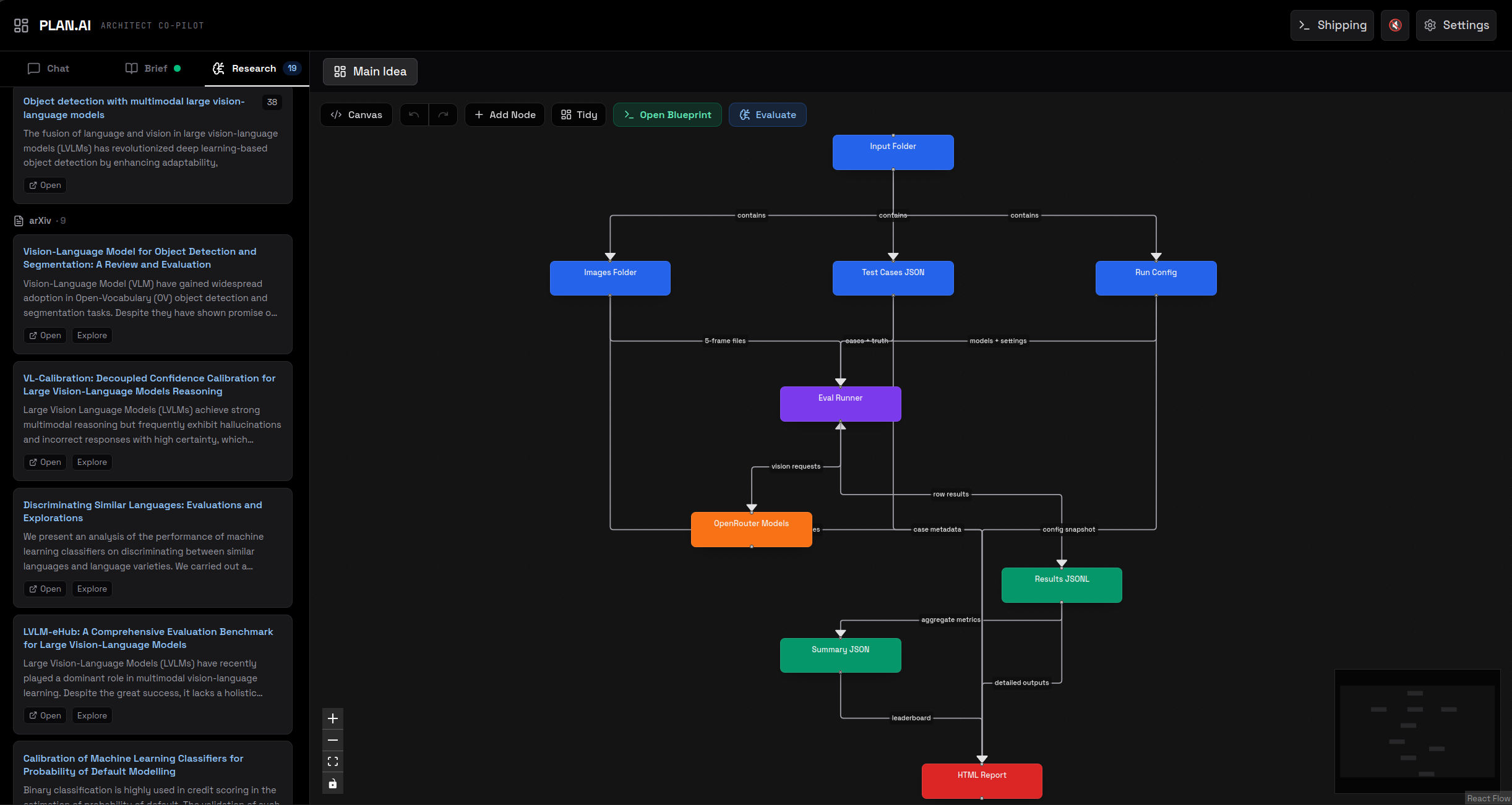
PLAN.AI workspace — deep-research run
PLAN.AI workspace — rendered blueprint
· captured 10 May 2026 · unedited workspace screenshots

9
Source Integrations
3
Research Depths
22
Blueprint Sections
3
Personas (STORM-lite)
6 — 9
Parallel Fan-out Queries
0
Embedded Secrets in Deploy

Nine research surfaces.

Code, papers, threads, encyclopedias, and the open web — each surface is a separate integration with its own rate-limit, ranking, and citation format. The synthesizer treats them as typed evidence and inlines source anchors directly in the blueprint prose.

GitHub

Repo search, README extraction, language stats. Pulls real-world reference implementations into the synthesis.

📜

arXiv

Pre-print search by topic with abstract pull-through. Used as the primary academic substrate for novel methods.

🎓

Semantic Scholar

Citation graph + venue metadata. Disambiguates and ranks methods by influence.

💬

Reddit

Community signal — what practitioners actually deploy and where the sharp edges are.

Stack Exchange

High-precision technical answers. Tag-filtered, score-weighted.

📚

Wikipedia

Disambiguation + canonical-definition substrate. Anchors specialist terms before the synthesizer expands them.

📰

Hacker News

Fresh discourse on tooling, deployment, and infra trade-offs at the engineering tier.

🧭

Tavily

Search-grade web retrieval with answer extraction. The general-web fallback when the specialist sources go quiet.

🔥

Firecrawl

Structured page-to-markdown extraction for arbitrary URLs. Used when the user pastes a link directly into a workspace.

Quick. Standard. STORM.

Three depths, three different cost / quality trade-offs. Quick is cheap and fast for spike research. Standard is the everyday one-call pipeline. Deep wakes up a STORM-lite orchestrator that recruits three personas and runs them in parallel against the source surfaces.

Tier 01

Quick

Single LLM pass against a curated 2-source mix. Useful for "what is X, who works on it, where do I read more" briefs.

  • ~1 LLM call
  • 2 source surfaces
  • Inline citations only
  • < 30 s typical
Tier 02

Standard

Plan → fan-out → synthesize. The agent first decomposes the topic into 4 — 6 questions, fans out to all 9 sources, then synthesizes a 22-section blueprint with cited prose.

  • 4 — 6 fan-out queries
  • All 9 source surfaces
  • 22-section blueprint
  • Mermaid C4 diagram inline
Tier 03

STORM-lite Deep

A multi-persona orchestrator (Engineer / PM / SRE) generates 6 — 9 parallel fan-out queries with role-specific framings, then a synthesizer reconciles the three perspectives into a single cited blueprint.

  • 6 — 9 fan-out queries
  • Three persona viewpoints
  • Cross-persona reconciliation
  • Workspace-branchable findings
⌬ STORM-lite personas
ENGINEER

Asks how it's actually built. Pulls implementations, dependency graphs, perf trade-offs, gotchas.

PRODUCT

Asks who pays for it. Pulls competitive landscape, user pain, pricing signals, adoption traction.

SRE

Asks what breaks at 3 AM. Pulls deployment topology, observability requirements, failure modes, capacity planning.

22 sections. One blueprint.

Every successful run produces a single artefact: a 22-section technical blueprint. Sections cover problem framing, related work, system architecture, data layer, model layer, deployment, observability, threat model, roll-out plan, and explicit risks. Every claim is anchored by an inline citation back to a source surface.

Block · Diagram

Mermaid C4 inlined

The blueprint embeds a Mermaid C4 system diagram with components, containers, and data-flow arrows. Renders client-side; users can fork-and-edit in place.

Block · Citations

Inline source anchors

Every concrete claim points back to a numbered source from the run's evidence pool. No floating assertions; clicking a citation opens the underlying source in a side-pane.

Block · Branching

Workspace branching + merge

Right-click any reference to spawn a sibling workspace explored independently, then fold its findings back into the parent blueprint with a merge action.

Block · Topology

React-Flow + dagre layout

Workspace topology is rendered as a React-Flow graph with dagre auto-layout. The whole research session is itself a navigable, persistable structure.

Block · Voice

ElevenLabs narration

Optional voice-over of any section via ElevenLabs. Useful for solo review on a walk; the blueprint reads itself back to you, citations included.

Block · Persistence

localStorage workspaces

All workspaces and the current blueprint persist locally — no auth required, no server-side user data, no PII leaving the browser.

A sample run — GuardPilot.

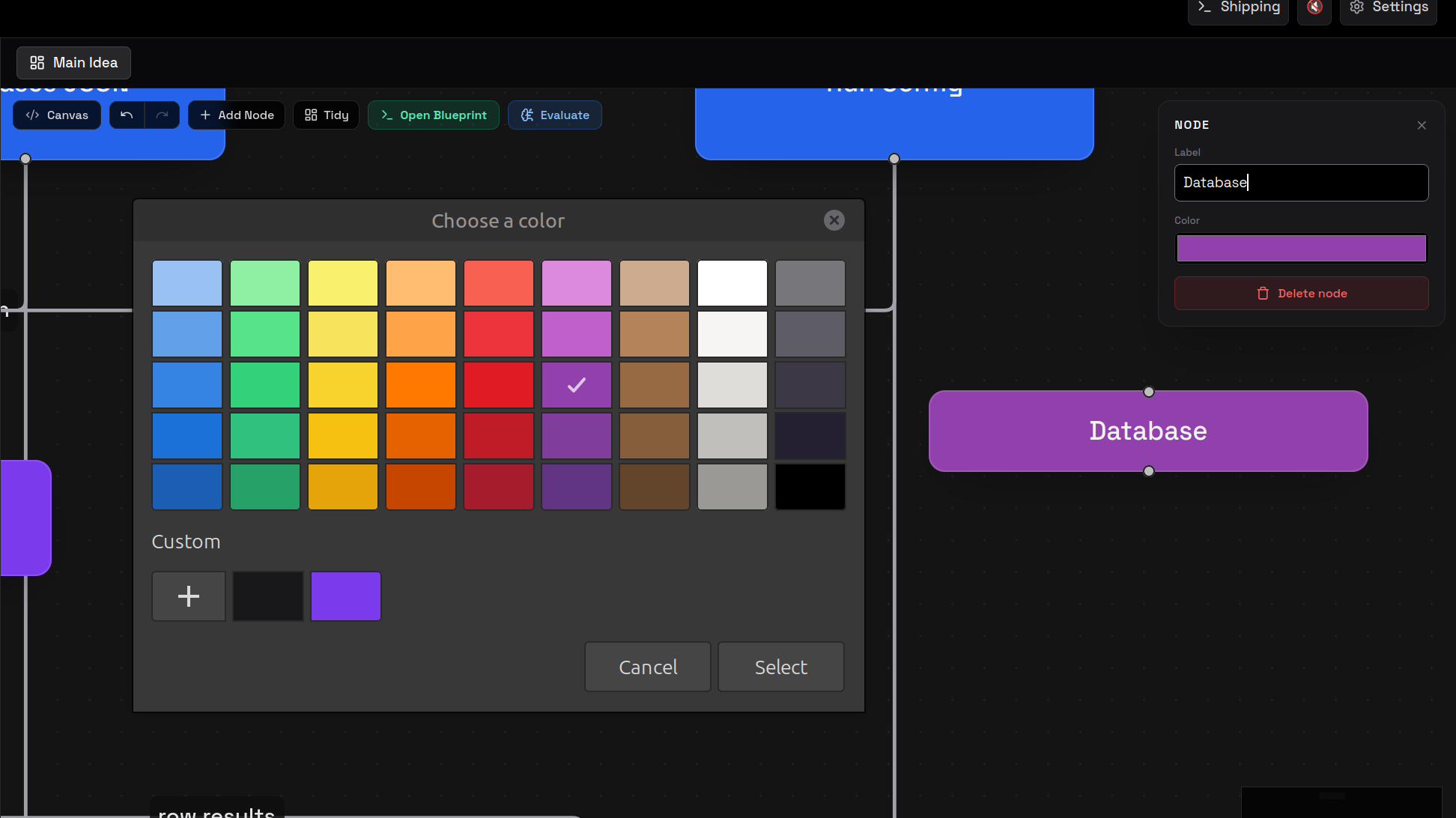
These are unedited outputs from a real PLAN.AI run on 12–13 May 2026 — the topic was a 24-hour security-loop hackathon idea (CCTV → YOLO tracking → simulated PTZ → OpenAI Vision verification → audit trail). The diagram on the left is the live render of the system architecture; the document on the right is the full 22-section blueprint, served as a side artefact instead of being inlined into this page.

▶ Sample diagram · Mermaid C4 render

Recorded 13 May 2026 · 02:27. A live walkthrough of the rendered diagram and the planner UI — the same architecture that maps to the Architect / Executor / Auditor lanes in the Shipping Floor below.

▤ Sample plan · 22 sections · 853 lines

GuardPilot — 24-hour security-loop blueprint

STORM-lite depth, three personas, inline citations, embedded Mermaid C4. The unedited PLAN.AI output — not a hand-curated demo. Preview the full rendered document in-browser with diagrams, or download the raw markdown.

  1. Executive Summary
  2. Context & Problem
  3. Goals
  4. Non-Goals
  5. Stakeholders & Personas
  6. Constraints
  7. Solution Strategy
  8. Architecture
  9. Quality Attributes — NFRs
  10. Cross-Cutting Concerns
  11. Security Considerations
  12. Operational Considerations
  13. Stack Decisions — Mini-ADRs
  14. Phased Rollout & Milestones
  15. Cost Estimate
  16. Success Metrics
  17. Risks & Technical Debt
  18. Open Questions
  19. Alternatives Considered
  20. ADR Log
  21. Glossary
  22. References

The Shipping Floor.

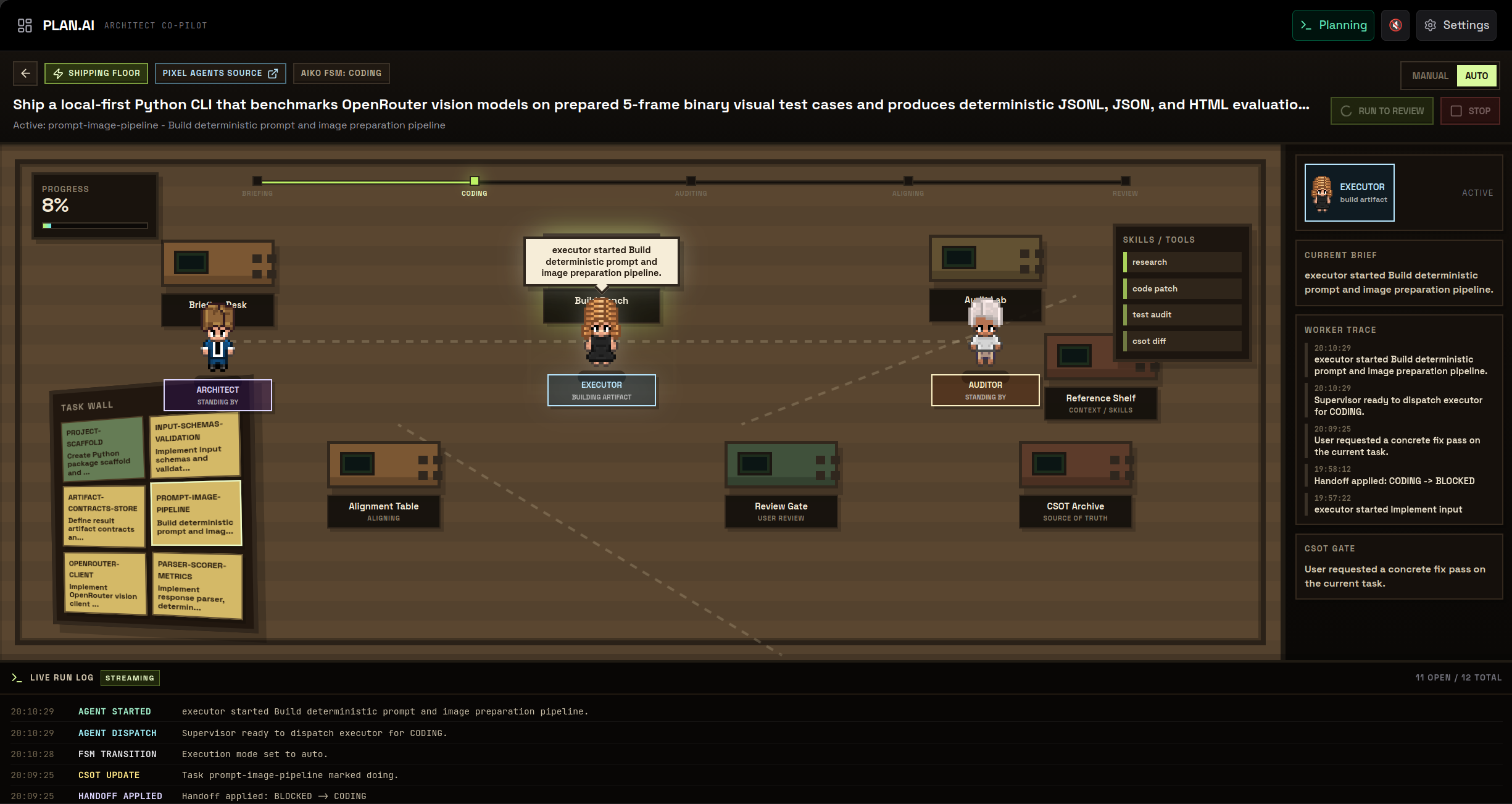
A blueprint is only useful if it ships. The Shipping Floor compiles every successful run into a three-lane task list — Architect, Executor, Auditor — directly executable by an upstream agentic runner. The same Architect / Executor / Auditor pattern Aiko's factory implements, here exposed as a planning artefact rather than a runtime.

⌬ Lane 01 · Plan

Architect

Tasks that define and ratify scope: spec writing, interface contracts, decision records, Mermaid diagrams. The blueprint pre-populates this lane from sections 1 — 8.

⚙ Lane 02 · Build

Executor

Tasks that produce code: scaffold, implement, integrate, write fixtures. Pre-populated from sections 9 — 16 of the blueprint.

⚖ Lane 03 · Verify

Auditor

Tasks that gate-keep delivery: tests, lint, security scan, deployment validation, observability check. Pre-populated from sections 17 — 22.

Vite. Vercel. Zero secrets.

The whole stack ships to Vercel as a static React build with a single serverless catch-all handler. No backend DB, no auth, no embedded API keys — every key the user wants to use is entered client-side and persisted only in localStorage. Public demos can be cloned and run with the cloner's own keys.

Build
Vite + React + TypeScript
Dev Proxy
Vite proxy → /api
Edge Function
api/[...path].ts catch-all
State
localStorage only
Streaming
SSE markdown chat
Render
Block-memoized markdown
Voice
ElevenLabs (optional)
Embedded keys
None — client-supplied

Watch the full run.

Twelve minutes from one-line idea to a downloadable 22-section blueprint with rendered Mermaid C4. No cuts, no edits — the same path the Shipping Floor consumes upstream.

▶ PLAN.AI · Full End-to-End Walk-Through

Recorded 14 May 2026 — unedited end-to-end run: idea → research → blueprint → diagram → shipping floor.

Welcome.

Holo